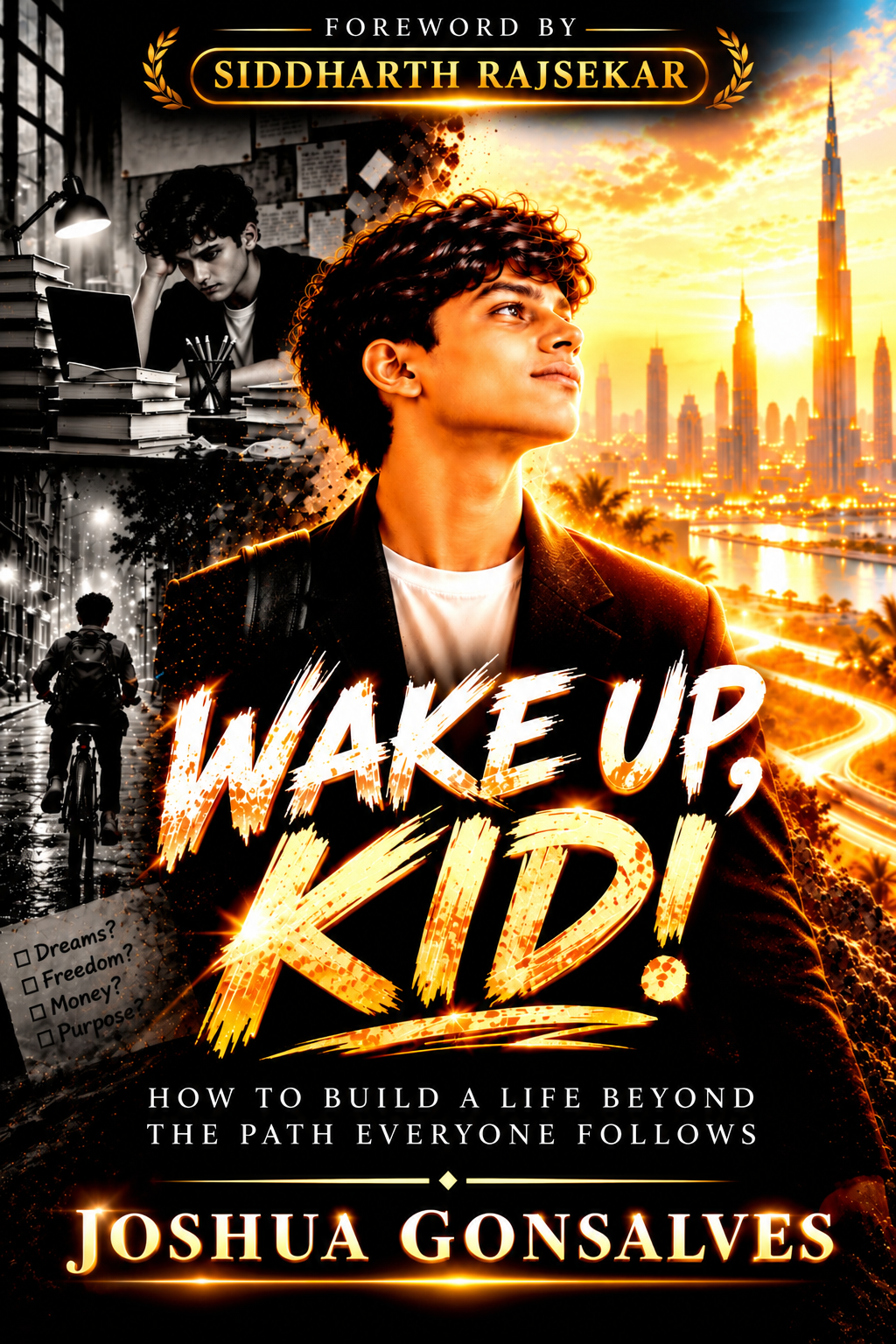
Joshua Reads · Book 1 · Free preview
Wake Up, Kid!
How to build a life beyond the path everyone follows.
Joshua Gonsalves
👉 Tap the left or right side (or use ← → keys) to turn the page
To Spiritual Powers of the Universe,
Who guided me & inspired me to contribute to the Golden Age.
To My Younger Self,
For believing in himself.
To My Mentor,
Who showed me the light when I was in darkness.
To My Family,
For being my pillar of strength.
Foreword
If there is one thing I have learned over the years, it is that the world opens up in extraordinary ways when you develop the courage to think for yourself.
We live in a time when a young person with curiosity, access to technology, and the willingness to learn can explore opportunities that were unimaginable just a generation ago.
Artificial Intelligence is transforming industries. Knowledge is available at our fingertips. The ability to learn new skills, connect with people across the world, and turn an idea into something meaningful has never been greater.
And yet, I believe one of the most important things we can teach the next generation is something remarkably simple.
Learn to think. Learn to act. And learn to create value.
When I came across Joshua Gonsalves and his book, Wake Up, Kid!, I found myself appreciating the curiosity and initiative of this young author.
Here is a student from Mumbai who began asking questions about the path that so many of us grow up believing we must follow.
Study hard. Get good marks. Enter a good college. Find a secure job. Build a comfortable life.
It is a familiar path, and one that has served many people well.
But Joshua began exploring what else might be possible.
He started looking beyond his study table, discovering the importance of practical skills, mentorship, meaningful relationships, entrepreneurship, and learning through experience.
And somewhere along the way, he discovered a lesson that I believe every young person should understand.
Knowledge becomes powerful when you put it into action.
In my own journey as an entrepreneur and mentor, I have seen this principle come alive countless times.
People can spend years collecting information, reading books, attending courses, and preparing for the perfect opportunity. But real growth begins when they take what they have learned and start applying it.
You learn by doing. You gain confidence through experience. And with every step, you begin to understand yourself a little better.
That is one of the ideas I appreciate most about Joshua’s book.
He speaks about implementation, the influence of our environment, the importance of surrounding ourselves with the right people, and the need to develop skills that will remain valuable in an increasingly AI-driven world.
I am particularly glad that he recognises the importance of empathy, communication, creativity, and problem-solving.
These are qualities that will help young people navigate a future filled with possibilities.
What also stands out to me is Joshua’s emphasis on family, gratitude, spirituality, character, and service.
Because as we encourage young people to dream big, we must also help them stay grounded in the values that give those dreams meaning.
Success becomes deeply fulfilling when the work we do improves the lives of others.
And that is a lesson worth learning early.
There is something else I admire about Joshua.
He has chosen to share his experiences while he is still discovering his own path.
I think that takes courage.
He has many chapters of life ahead of him. There will be new lessons, unexpected challenges, exciting opportunities, and moments that will shape the person he becomes.
And I hope he continues to approach each one with the same curiosity and willingness to learn that inspired him to write this book.
To every young reader holding Wake Up, Kid!, I want to leave you with a thought.
You have something valuable to contribute to this world, even at your age.
Start with what you know. Develop the skills you need. Find people who inspire you. Ask better questions. Take responsibility for your choices. And look for opportunities to make a positive difference in someone’s life.
You will discover your strengths along the way.
And to the parents and educators reading this book, I hope we continue to create environments where young minds feel encouraged to question, experiment, express themselves, and grow into responsible individuals.
Joshua, congratulations on taking this step and putting your experiences into words. I hope this book marks the beginning of a lifetime of learning, creating, and contributing.
The future belongs to those who are willing to learn, take action, and create meaningful value.
And the beautiful thing is, you can begin today.

Before You Begin
This book is not written by AI.
Every single line in here is my own story. My own life. Typed by me, at my own desk, on the same old laptop you will read about.
I know how that sounds in 2026. Today you can ask AI anything. How to study. How to earn. How to build a business. It will answer in two seconds, and most of the answers will even be correct.
Knowledge is everywhere now. You are already filled with knowledge. So I don't want to give you more knowledge.
I want to give you something no AI can give you, because it doesn't exist anywhere else: what actually happened to me.
Nothing in this book is fictional.
- My success is real.
- My failures are real.
- My pain is real.
- My struggles are real.
- Every rupee is real.
And I will only tell you what I have actually done. Not what I think you should do. Not what I am planning to do one day. What I did. I am an implementer. I don't talk about things I haven't lived.
One more thing. Please read this book from the start. Don't skip chapters. This is not a book of tips you can open on any page. It is a story. If you jump ahead, the ending won't mean anything to you.
Introduction
The Seed and the Soil
Right now, I am sixteen years old. In about a month, I will be seventeen.
I was born and brought up in Mumbai. My whole family is from Mumbai. But my grandfather, after years of city life, wanted something quieter. So he bought a house of his own in Kerala and went to live there, surrounded by coconut trees, rain, silence, and more wild creatures than I was ever ready for.
Every year, one by one, all of us cousins go and stay with him there. Remember that house. It comes back in this story, and some things that happened there, I still can't believe happened to me.
Right now, as I type this, I am in Class 12. My board exams are coming.
And in the last one year, I have generated more than ₹3 lakhs in revenue from my own work on the internet.
I almost didn't put that number on the first page. I am not saying it to show off. I am saying it because a few years ago I was the boy who couldn't find a few rupees for an auto rickshaw when he needed it most. The boy who scored 78% in Class 9. The boy who sat at his study table every night asking the ceiling one question:
What am I even doing with my life?
If you have ever asked yourself that question, this book is for you.
What this book is not
This is not a "get rich quick" book. I didn't get rich quick. It took a year of work, months of earning absolutely nothing, a lot of rejection, and a lot of teasing at the dinner table.
This is also not a book that tells you to hate your teachers or fight with your parents. My parents are a big part of this story, and I love them.
This is a book about one boy waking up.
A few frames from the journey
I won't tell you everything here. That would spoil it. But here is what is waiting for you.
- A cycle chain that came off four times, in the rain, on the one day it couldn't.
- A shopkeeper who said one word I have never forgotten.
- A three-year-old laptop that froze at the worst moments.
- A voice in an ad that told me I was being selfish.
- A coupon code with my own name in it.
- A chair with only three good legs.
- A cobra.
- A crow, and what it did to my keyboard.
- A grandfather's blessing, and what reached my bank the very next day.
- A date in September I now believe is a little bit sacred.
- And the day I paid, with my own money, to take my father to meet the man who changed my life.
Every one of those moments is real. Every one taught me something school never did.
How to read this book
Read it in order. Each chapter opens a door to the next one. Some doors I will only half open, and you will have to keep reading to see what's on the other side. That's on purpose.
I want to thank you once again for investing in this book. If you put these steps into practice with a clear focus, they can change your life and the life of your family. The world needs committed people and leaders, and I am proud that you are stepping into this journey
At the end of every chapter, there is a small Wake-Up Exercise and one Wake-Up Question. Don't rush past them. Take a real notebook. Write.
Seeds
The ideas offered in this book are seeds, seeds in search of fertile ground. When those seeds are properly sown, watered, and exposed to sunlight, they stand a good chance of bearing fruit. But those same seeds often lie dormant as mere potential until they are activated.
I can give you the seeds. Only you can be the soil.
If you read this and keep it on a shelf, the seeds will sit there, quietly, doing nothing. But if you take even one and plant it in your life, water it every day and give it some light, something will grow.
Something grew in me. And it started on the back seat of my father's cycle.
Let's begin.
Chapter One
Before the Alarm
The loop starts before you even open your eyes.
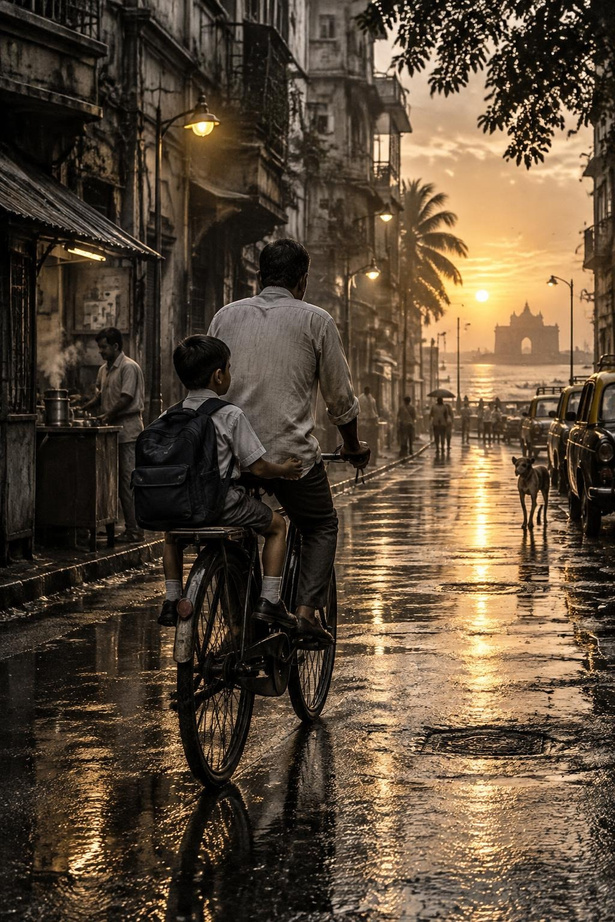 AI-generated image for illustration only
Mumbai. Early morning.
The alarm hasn't rung yet.
The house is still quiet.
Somewhere, a pressure cooker whistles in another flat.
And I'm already awake, staring at the ceiling, thinking about the day.
School. Then tuition. Then foundation classes. Then homework. Then sleep. Then the alarm again.
That was my life for years. I want to start right here, before the alarm, because this is where most of us live. In that small gap between waking up and starting the same day all over again.
First, let me clear something up
When people hear stories like mine, they imagine a poor boy from a struggling family who suddenly became rich. That's not my story.
My family was doing well. My father had bought our own house years ago, with his own money. We had no loans. No EMIs. No debt. Nothing hanging over our heads. My mother has worked a 9-to-5 job for as long as I can remember. We were happy. We had a home, good food and each other.
But there was one strange thing about our house.
We never bought a vehicle. No car. No bike. Not even a scooty.
I still don't fully know why. It wasn't that we couldn't. Maybe my parents just didn't see the need. Nobody questioned it, and I never forced the topic.
So in my early school days, I went by school van. Two, maybe three years of that, squeezed in with other kids, bags on our laps, the van honking through traffic.
And then, one year, the van stopped.
And the cycle started.
The back seat
My father had an old black cycle. Heavy. The kind that makes a small creak every time the pedal goes round.
He sat in front.
I sat behind him on the metal carrier.
School bag on my back.
My hands holding his shirt.
Mumbai rushing past on both sides.
I want to tell you the truth about how I felt on that seat, because this book only works if I'm honest.
I loved my father.
And I was embarrassed.
At the school gate, other kids stepped out of cars. Some came on their fathers' bikes. Some came laughing out of vans with their friends. And there I was, climbing down from the back of a cycle, fixing my shirt, pretending I didn't care who was watching.
I always cared who was watching.
I was a shy boy. I would keep my head down at the gate and walk fast, as if speed could erase where I had just come from.
My father never said a word about it. He would turn the cycle around and pedal off, sweating in the Mumbai heat, so his son could reach school on time.
It took me years to understand what that cycle was really carrying.
It wasn't just my body. It was his love.
The man in front of me
You will meet my father again and again in this book, so let me tell you about him.
When he was younger, he was a gym trainer. He trained the heads of big companies. Somewhere inside him there was a small entrepreneur, though life slowly pushed that part of him into the background.
He is strict. Very strict. But his strictness comes from fear, the kind every parent has when they imagine their child falling. If I succeed at something, he is happy. He just wants to see the result first.
And there is one thing about him I am deeply proud of. In his entire life, my father has never gone near any kind of addiction or bad habit. Not once. Clean, simple and disciplined, Every. Single. Day.
I have followed him in that. And I hope, I always will.
Three places, one boy
Then came Class 8. And this is the part people find hard to believe about me.
I was a serious student. Not pretend serious. Actually serious.
You know how lots of students join "integrated" coaching after Class 10 to prepare for JEE or NEET? I went even earlier. In Class 8, I went to my parents and told them I wanted to join JEE foundation classes.
They looked at me like I had lost my mind.
"Are you crazy? You'll go to school, you'll go to tuition, AND you'll go to foundation?"
"Yes," I said.
"I want to go."
Nobody pushed me. I chose it myself.
So for Class 8 and Class 9, my days looked like this: School.
Tuition.
Foundation.
Homework.
Sleep.
Repeat.
The institute was about three kilometres from home. I cycled there and back. Six kilometres a day, on top of everything else. We were just fifteen students in that batch. Not a hall of a thousand. Fifteen serious kids who had chosen to be there.
Even after choosing that foundation, I didn't keep taking it as seriously later in 11th & 12th. After Class 10th, I joined a normal college, not an integrated program, the reason I will be reveling in the further chapters.
Around Class 8, I got my own cycle. It was second-hand. Its chain had a bad habit of coming off.
Remember that chain. It's going to change my life in the next chapter.
The important year
Every Indian student knows this line.
"This year is very important."
In Class 8, Class 8 was the important year. In Class 9, Class 9 was. In Class 10, obviously, it was the most important year of my life. And now, in Class 12? Guess. Years later, I read a scene in my mentor's book that took me straight back to those classrooms. A teacher walks into a noisy room and tells the students, more or less, that if they enjoy this one year they will suffer their entire life, and if they suffer this one year they can enjoy the rest of it. The whole room goes silent.
I smiled when I read it. Because I knew that silence.
But nobody ever told me which year was "this one year." In my life it never ended.
It kept moving one class ahead of me, like a carrot on a stick.
Suffer now, enjoy later.
And "later" never had a date.
Somewhere deep down, the real message started to sound like this: Study for your entire life.
Just keep studying.
Don't ask why.
The sentence that hit me hard
One evening in foundation, in a chemistry class, it happened.
The teacher was writing on the board.
He stopped.
He turned around and looked at the fifteen of us.
And he said it casually, like it was nothing.
“Bhai, tum sab jo yahan seekh rahe ho na, AI ki wajah se kuch saalon baad shayad woh kisi kaam ka bhi nahi rahega.”
The room went quiet.
Then he turned back to the board and continued the chapter, like he hadn't just dropped a bomb in the middle of the room.
But I couldn't continue.
I sat there with my pen frozen.
The person telling me this wasn't a random guy on the internet.
It was the teacher.
The man standing in front of the very class I had begged my parents to let me join.
That realisation hit me hard.
If even he thinks this won't matter... then what am I doing here?
I cycled home that night, three kilometres in the dark, and the question rode with me the whole way.
The boy outside the marks
And the funny part? After all that seriousness, I wasn't even good at studies.
I'm not saying that to sound humble. I made silly mistakes. I struggled to speak in front of people. And memorising, the one skill the whole system is built on, was my biggest weakness. I would read a page five times and forget it by morning.
In Class 9, after all that school, all that tuition, all that foundation, all those kilometres, I scored 78.
I stared at that number and felt something cold settle in my chest.
Not anger.
Confusion.
I had done the loop perfectly.
So why wasn't I moving?
What nobody wrote on my report card was everything else I was.
I loved sports. I could draw. I danced, really danced, the kind where you forget anyone is watching.
I sang. I was alive in all the places the timetable didn't measure.
My parents never told me to stop.
But every conversation ended the same way, said with love and with worry.
Study. Get a degree. Graduate. Be safe.
The question at the desk
There is one picture of myself I keep coming back to.
- Me, around fourteen.
- Back from tuition.
- At my study table.
- The fan going round and round.
Books open.
Nothing going in.
And one question, over and over:
What am I even doing with my life?
It's not a dramatic question when you're fourteen.
Nobody notices you asking it.
You just sit there, the question sits next to you, and then you go to sleep.
And the next morning, before the alarm, the loop begins again.
If you are that boy or that girl right now, hear this: that question is not a sign that something is wrong with you. It's the first sign that something inside you is waking up.
The day you start asking "why am I doing this?" is the day the loop starts to crack.
A small disclaimer
I'm in Class 12 now, and my boards are coming. So let me tell you something right now, so it's clear between us.
A year after that 78%,
I scored 92% in Class 10.
You'll find out exactly how in Chapter 3, and it has nothing to do with studying harder.
And in Class 11, I scored 70%.
But once my Class 12 results come out?
Don't you dare ask me my percentage.
It's going to be low.
And I'm okay with that.
By the end of this book, you'll understand why.
Where the loop breaks
I could have stayed in that loop forever. Most people do. Nobody ever shows them the door.
For me, the door didn't open with a big speech or a lightning bolt.
It opened on a normal exam day, on a normal road, with a normal second-hand cycle.
And a chain that decided, that one afternoon, to come off.
Not once.
Four times.
In the rain.
Chapter Two
Four Times in the Rain
Some lessons arrive gently. Mine arrived with black grease on both hands.
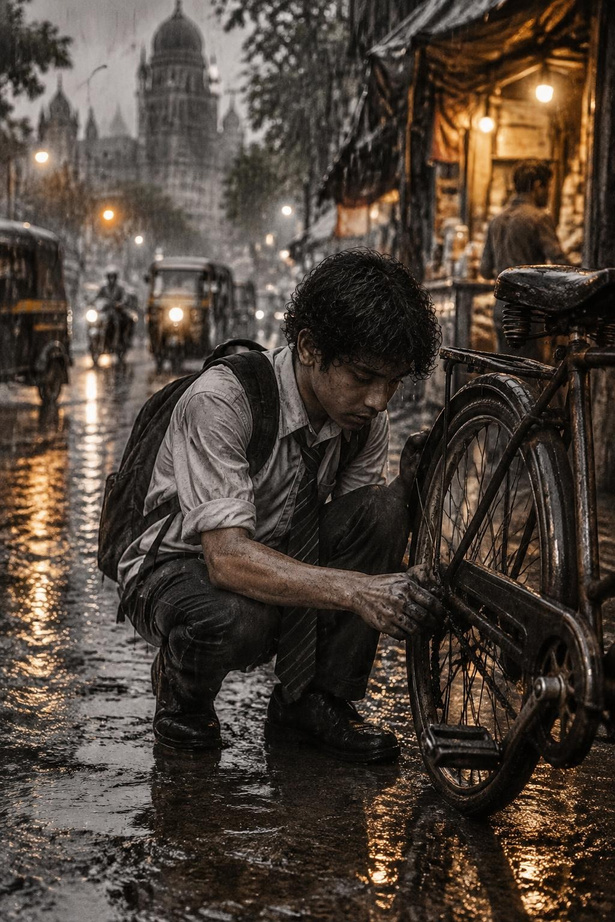 AI-generated image for illustration only
Class 9. Tuition exam week. Monsoon in Mumbai.
My tuition teacher was strict. I won't tell you his name, because this story isn't about him. But you need to understand one of his rules, because this whole day depends on it.
During exams, if you were late, you didn't enter.
Not one minute late. Not thirty seconds. The door was the door. Everyone knew it. Nobody tested him.
I cycled to tuition every day. That day, like most days, I left home with just enough time. Not one minute extra. The sky was dark grey. It had been raining since the afternoon.
I thought I'd make it.
The first time
I was pedalling hard.
Rain hitting my face.
Bag heavy on my back.
And then, suddenly, the pedals went light.
They spun under my feet with nothing to push against. That sick, empty feeling.
The chain had come off.
I jumped down, crouched at the side of the road in the rain and pushed it back onto the teeth with my fingers. My fingers came away black. I got back on and pedalled even harder.
The second time
Further down the road, it happened again.
Down.
Crouch.
Fingers into the grease.
Push the chain onto the teeth.
Turn the pedal by hand until it catches.
Back on.
Now my palms were completely black. Oil in the lines of my hands, under my nails, on my wrists. The rain spread it everywhere. On my uniform. On my face, when I wiped the water out of my eyes.
The third time
When it came off the third time, I wasn't even surprised anymore. I just felt tired. A heavy tiredness that had nothing to do with my legs.
I fixed it again. I checked the time. The exam was starting in two or three minutes.
I wasn't close.
The fourth time
The fourth time, I gave up on the cycle.
I stood by the road, soaking wet, holding my black hands away from my uniform like they belonged to someone else.
If I walked, I'd never make it. If I ran, I'd still be late.
The only way was an auto rickshaw.
I reached into my bag. Usually, I kept a little money in there, a few notes in the front pocket of my tuition bag, for days exactly like this.
Front pocket.
Nothing.
Side pocket.
Nothing.
My pockets. Every corner of the bag.
Nothing.
That day, of all days, I had nothing.
One word
So I did something I had never done in my life.
There was a small shop by the road. I walked in, dripping water on his floor, and asked the man behind the counter if he could lend me some money for an auto. I told him I'd come back and return it. I told him it was an emergency. I told him I had an exam.
He looked at me.
At my black hands.
At my wet uniform.
At my face.
And he said one word.
"No."
Rejection doesn't hurt because of the word "NO" It hurts because it shows you exactly how small you are in that moment.
The ride
I'd love to tell you I cried. I didn't. I walked back into the rain, to the cycle, and did the only thing left.
I hung the loose chain over the handle so it would stop dragging. And I pushed. I rode when I could. I pushed again. When the chain went back on, it went back on. When it came off, it came off. I stopped counting.
Rain.
Grease.
Traffic splashing water at me.
Keep moving.
I reached tuition about fifteen minutes late.
I walked in. I didn't have to explain anything. My clothes, my hands, my face told the whole story. The class was silent, heads down over their papers.
The teacher looked at me for a long moment.
And then, maybe because of the state I was in, he moved aside and let me in.
I wrote that exam with grease on my fingers, leaving small black marks on every page I turned.
The walk home
Want to know something funny? I don't remember what marks I got in that exam. That's how unimportant the exam turned out to be.
What I remember is the way home. The rain had slowed to a drizzle. The broken cycle was beside me. And one thought kept beating in my head like a drum.
Without money, you are nothing in front of the world.
I know a book is supposed to tell you money doesn't matter. I believe a lot of that, and later in this book I'll show you how I came to see money in a much calmer way. But that day, I learned the other half of the truth. Our house had money. My parents had money. But standing on that road, I had nothing of my own. And because I had nothing of my own, every choice was gone.
I couldn't take the auto.
I couldn't fix the cycle properly.
I couldn't even borrow a few rupees from a stranger.
It wasn't that we were poor. We weren't.
It was that I was completely dependent. On my parents. On luck. On a shopkeeper's mood. On a chain that couldn't stay on.
The table
I reached home and washed my hands for a long time. Grease doesn't come off easily. It stays in the corners of your nails for days, like it wants you to remember.
Then I sat at my table.
Same table.
Same fan.
Same books.
Same question.
But that night, the question had changed shape. It wasn't sad anymore. It had something sharp inside it.
I am not going to live my whole life like this.
I had no plan. No business idea. I didn't know a single person who had built anything outside a normal job. I had a second-hand cycle, a report card with 78 on it, and a chemistry teacher's sentence about AI still echoing in my head.
All I had was a decision.
First, you take the decision. Then you spend your whole life making that decision right.
I could have started this book with my first payout, or the day I met my mentor, or the day I crossed ₹3 lakh+. Those moments look good on a poster. But they would mean nothing without this day. Everything that came later grew out of that roadside, those black hands, and one word from a stranger.
If you've had your own day like that, hold on to it. Don't be ashamed of it. That day is fuel.
Mine was a chain that came off four times in the rain. What's yours?
What happens next
That night, I made a decision.
But a decision without a tool is just a wish.
The tool was already sitting in my room. A cheap laptop my family hated paying for every single month.
That laptop would teach me maths. It would fix my memory. It would take me from 78 to 92.
And one night, during a dance break, it would play an ad.
A man would speak for a few seconds.
He would tell me I was being selfish.
And my life would never be the same again.
Locked · Chapter 3: The Three-Year-Old Screen
You've only seen the beginning.
A three-year-old laptop. No contacts. No shortcuts. A 16-year-old who kept getting told to "just study."
And then — the first ₹27,000 landed in his bank account. Within a year, it became ₹3,00,000 in total revenue, built while still in school.
How did it actually happen? The real story starts in Chapter 3.
Page 1 of 1